

Are Tattoos An Inferior Good
How workplaces are phasing out the tattoo stigma
(Epitome credit:
Mykola Romanovsky
)
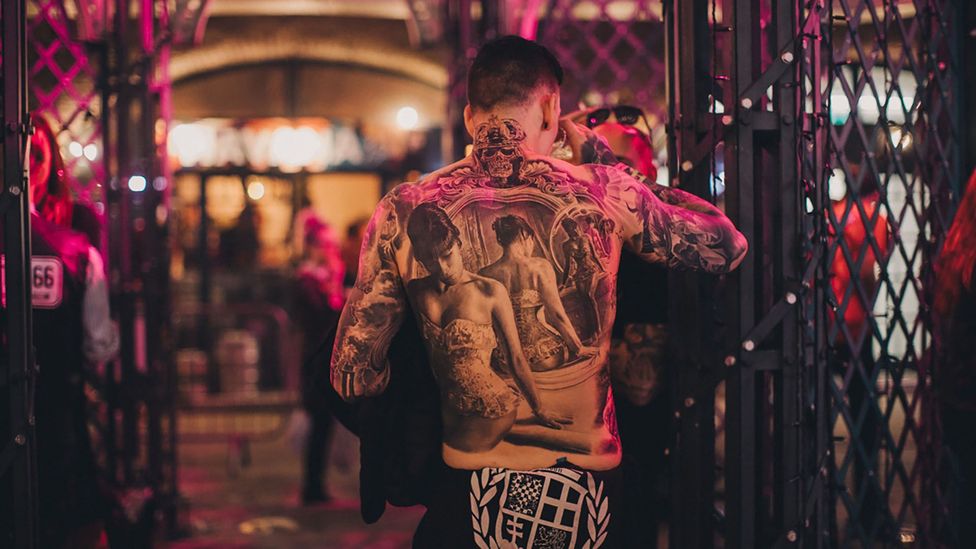
More people are getting tattoos – then workplaces must be keeping up, right? Well, information technology'south a bit more than complicated than that.
"In the last few years, tattooing's gone absolutely berserk." That's George Os's take on what he sees as the mainstream take-over of tattoos. Even at the London Tattoo Convention, which claims to be the biggest of its kind in Europe, Bone stands out. One time the United kingdom of great britain and northern ireland's almost tattooed man, he is yet in charge of his eponymous studio in London at 74 years of age. And he isn't impressed with the direction things seem to be going.
"Tattooing'south turned into a fashion accompaniment, which I'k all against, considering tattooing is non a fashion accessory, it's a way of life," he says. "I used to be dissimilar, outrageous, simply at present I'grand normal. I'll accept to think of something else!"
And while Bone might be underestimating his power to shock – it's not every day you run into a senior citizen with extensive body art – tattooing is becoming widespread in some countries. When Berlin-based market research company Dalia Research surveyed 9,000 people in eighteen countries in 2018, they plant that 46% of United states of america respondents had a tattoo, ascension to 47% in Sweden and 48% in Italy. Research in 2010 by the Pew Inquiry Centre found that 38% of US millennials had a tattoo (though 70% said their tattoos were not unremarkably visible).
In many places, tattoos are no longer the preserve of rebels on society's fringes. Take Anthony Fawkes, for example. An IT consultant for various investment banks, Fawkes is at the convention to exist inked by Nikole Lowe, 47, who owns Skilful Times Tattoo in Shoreditch, Due east London. She'southward working on an intricate dragon effectually Fawkes' left arm which will somewhen exist a five-role design.
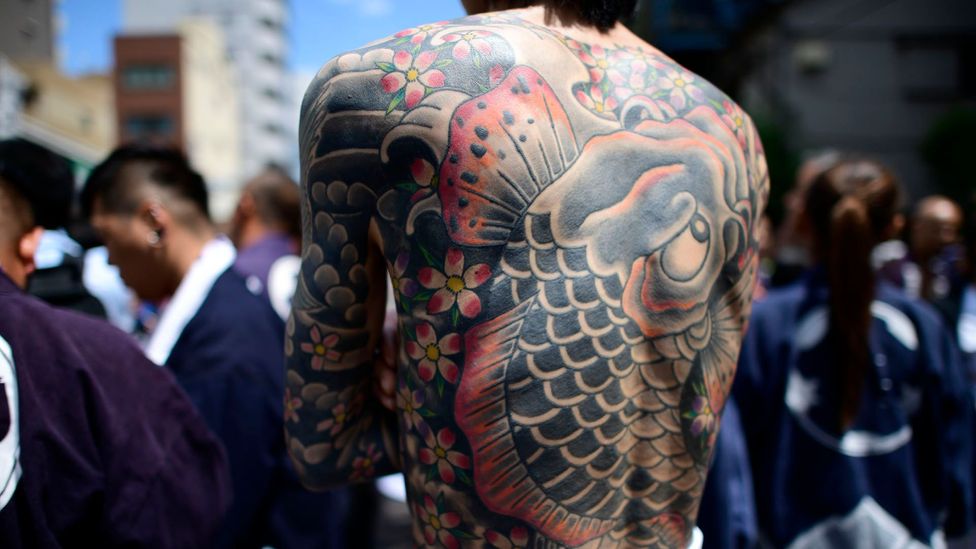
As the 2020 Tokyo Olympics near, Japan is forced to rethink its anti-tattoo tradition (Credit: Getty Images)
"I'grand having the Shaolin fighting animals; a snake, tiger, dragon, leopard and crane," says Fawkes, whose right arm is already inked with the tiger and serpent. "Initially I thought I'd have to cover them up at work, merely I recall it'south so accepted now, the simply reactions I get are complimentary."
Fawkes estimates that the total design will cost around £12,000 ($15,000) altogether, depending on how long it takes. Information technology's a big chunk of coin just then once more, information technology's non unusual for high earners in established professions to get inked. Senior figures in both business and politics have shelled out on tattoos, including Canadian Prime number Government minister Justin Trudeau and Lachlan Murdoch, executive co-chairman of News Corp. So it naturally follows that if national leaders and captains of manufacture do it, getting inked is officially adequate, correct? Well, not quite.
Social stigma?
While some may experience comfortable showing off their body art, in the Great britain, The states and many other countries information technology's still legal for companies to have a 'no tattoo' policy. Some institutions similar the US Army have detailed guidelines on what is and isn't adequate, while others grant exemptions for cultural reasons; in 2019 Air New Zealand dropped its 'no visible tattoos' policy partly considering it had meant that traditional Maori markings had to be covered up, creating a backfire.
Specific cultural exceptions aside withal, conservative corporate attitudes aren't necessarily out of stride with social attitudes. You might think that in countries where a high pct of residents had tattoos, at that place would exist a more relaxed view of body art, but that'southward not always the case. Inquiry conducted for the University of Northern Iowa by Kristin Broussard and Helen Harton reveals that fifty-fifty in the United states of america, wearing your art as a sleeve can effect in social stigma.
In their 2017 report, Broussard and Harton recruited two groups; one of students with an average age of xix and another from the general United states population with an average age of 42. Both groups were shown images of men and women with arm tattoos, then shown the aforementioned images but with the tattoos digitally erased. The groups were asked to rate the pictured individuals for 13 character and personality traits including honesty, success, trustworthiness and intelligence.
Apart from the students viewing women with tattoos as being 'stronger and more than independent', participants in both age groups generally rated individuals with an arm tattoo less favourably than the image of the same private without the tattoo. Broussard said she was surprised "on the surface" that the 2 groups held similar views. "A lot of 19-year-olds have tattoos, so y'all would think that they would exist more OK with them," she says.
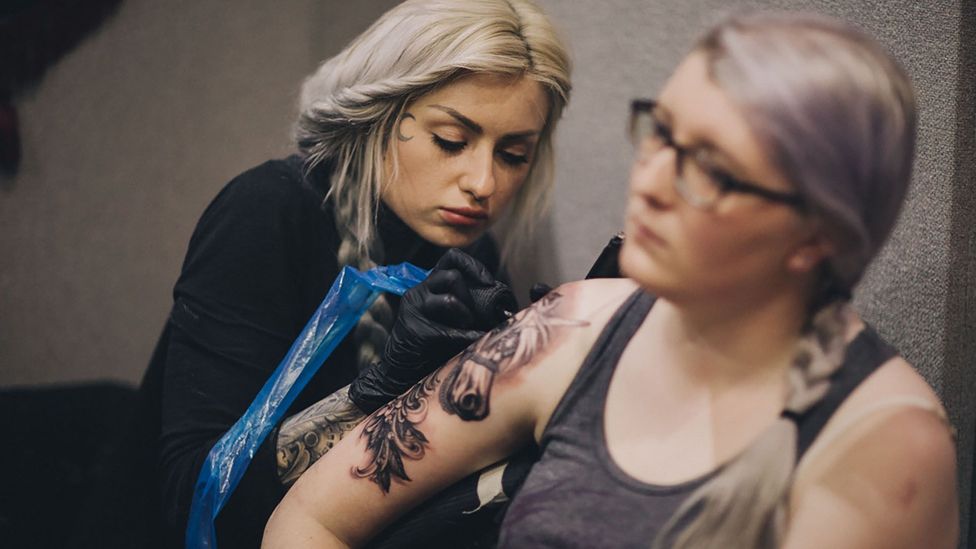
Although 38% of U.s. millennials have a tattoo, just xxx% say they keep it visible (Credit: Mykola Romanovksy)
But Broussard says that even when people have tattoos themselves, they can concord negative views on the discipline. "People tend to internalise stigma. It doesn't really thing if yous take that identity or you have that characteristic like owning a tattoo. If in that location'south a very strong societal stigma confronting it, you volition internalise information technology and withal believe it. It'southward this attitude that it's OK for me, but not for them," she explains.
'Calibration of acceptability'
So fifty-fifty if you're a CEO with a tattoo you might not hire someone who has one. Johnny C Taylor Jr, president and CEO at the US-based Club for Man Resource Direction, which represents around 300,000 HR professionals globally, says in that location'south a sliding scale of acceptability when it comes to tattoos.
"In terms of nearly adequate to least acceptable, if you tin can hide it, information technology'due south OK. Then at that place's the employers who say y'all can accept a tattoo, simply information technology shouldn't be a distraction; information technology covers half your face up or is something that might offend other people, like a scantily-clad adult female on the biceps of a man. Lastly, in that location'southward the category of just not acceptable, and that typically means when tattoos testify up on your face and information technology's something that no i can avert looking at, [or] when the nature is truly controversial, a swastika for case.
"More bourgeois industries, for example financial services, banking and healthcare, are going to be more bourgeois when information technology comes to tattoos," Taylor adds. "We observe a lot more liberal policies in amusement, even in corporate entertainment where people at the most senior levels might have a visible tattoo. Those individuals would never practise that if they were senior executives at a banking company."
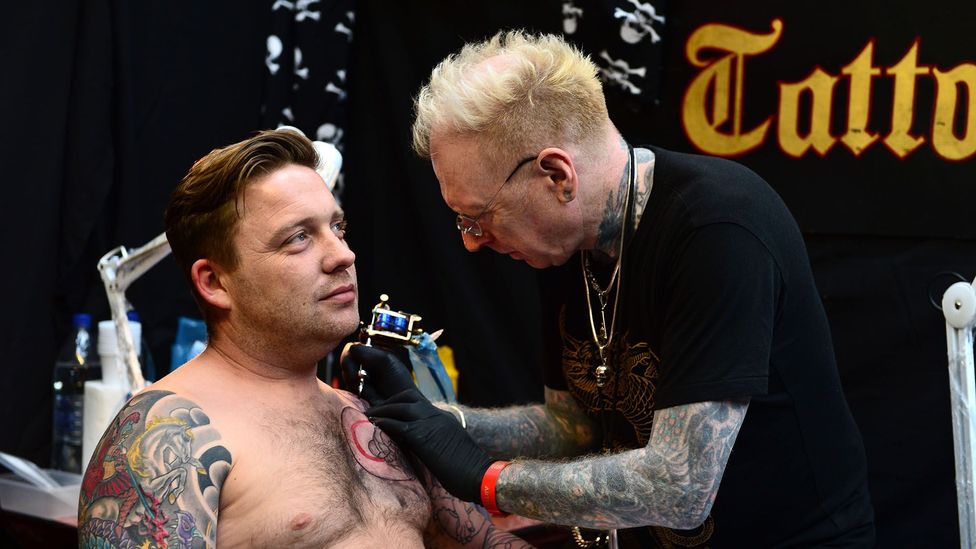
George Os, in one case the UK's near tattooed man, decries the current tattoo-equally-way era (Credit: Getty Images)
And in some countries, the very thought of a tattooed CEO is across the pale: Nihon in particular has a fraught relationship with the fine art form. Tattoos have long been associated with yakuza, the Japanese gang members who were known for having intricate designs equally a testify of wealth, masculinity and the power to endure pain. Tattoos were against the law until 1948 and, seventy years subsequently, they're still not generally seen as socially acceptable. The 2019 Rugby Earth Loving cup and the upcoming Olympics in Tokyo this twelvemonth accept highlighted the issue; in a country where displaying tattoos in public is taboo, should athletes and spectators cover upward their body art?
This conservatism frustrates Yutaro, who co-owns Carmine Signal studio in London but is originally from Chiba, almost Tokyo. Taking a suspension from inking a customer with Hakutaku, a monstrous beast from Japanese and Chinese mythology, Yutaro – who goes by i name – vents his irritation. "Tattooing is a cultural phenomenon; people decorate their body to feel a certain way, only people in Japan are having a hard time breaking out of their mindset," he says.
Attitudes almost tattoos are frequently equally complex as the designs themselves, just for fans of permanent body art, it's a trend that's hither to stay.
Source: https://www.bbc.com/worklife/article/20200113-normalising-the-workplace-tattoo-taboo
Posted by: brownforsoust77.blogspot.com
0 Response to "Are Tattoos An Inferior Good"
Post a Comment