

Should A Mother On Welfare Get A Tattoo
 © AP
© AP
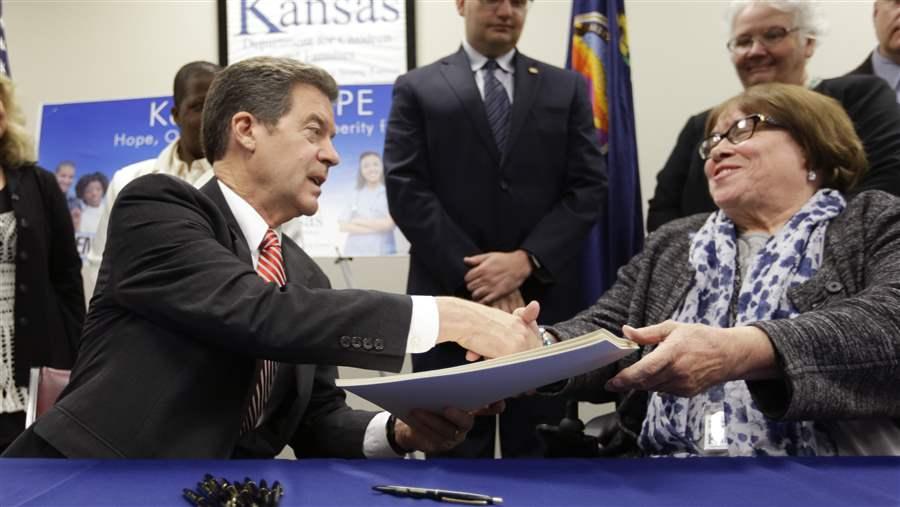
Republican Gov. Sam Brownback of Kansas, left, shakes hands with an adviser afterward signing a bill disallowment welfare recipients from buying certain items with their benefits. Eighteen other states are considering comparable restrictions. (AP)
Kansas' new police that restricts welfare recipients from using their benefits to get a tattoo, consult a psychic or take a cruise has made for endless fodder on the late-night talk show circuit.
Supporters argue the law volition push the poor to obtain gainful employment, and 18 other states are weighing comparable measures. But welfare policy analysts from beyond the ideological spectrum question the wisdom of the restrictions.
Analysts say the Kansas law, the nation's nigh restrictive, saddles welfare recipients with extra bank fees because information technology limits ATM withdrawals to $25; prohibits a state agency from using state or federal funds to educate needy families almost food stamp eligibility; and makes it more difficult for the poor to pay their rent or buy cheaper gasoline in neighboring Missouri.
Groups such as the left-leaning Eye on Budget and Policy Priorities (CBPP) accept sharply criticized the Kansas law. Liz Schott, a senior young man at CBPP, said the police force stigmatizes welfare recipients by creating the impression that they are gaming the system.
Rachel Sheffield, a policy analyst at the conservative Heritage Foundation, also questioned the effectiveness of Kansas' strategy. Sheffield said there is no testify of widespread fraud involving Electronic Benefit Transfer (EBT) cards, which function like debit cards. Passing laws restricting the use of benefits is easier than crafting truly effective policy, she said.
"There are stories that will come out about individuals spending their dollars on casinos, and people get riled upwardly about those things, which is understandable. So you lot have policymakers putting forth these kinds of laws," Sheffield said. "Merely this doesn't get to the heart of what is needed for reform."
From Welfare to Piece of work?
The Kansas constabulary codifies policies that the Kansas Department for Children and Family Services has had in place since 2011, said Theresa Freed, the department'due south manager of communications. Some of the police'southward more controversial components, such as the $25 ATM limit, were the result of amendments introduced by lawmakers, she said.
The law too bans the use of EBT cards to pay for a wide diversity of items and services, from alcohol to amusement parks, massage parlors, concerts and sporting events.
"The law is actually about encouraging individuals to become employed. We believe that employment is the near effective path out of poverty," Freed said.
Between 2013 and 2014, she said, more than half-dozen,000 welfare recipients In Kansas obtained employment. Some of those people now earn plenty that they no longer authorize for aid, while others still need some help.
"The policies that we've enacted take been effective in helping individuals getting back to work," Freed said.
But land Sen. Anthony Hensley, a Democrat from Topeka, said the constabulary is an "overreach."
"It harkens to the days of President Ronald Reagan where he talks most the welfare queen that drove a Cadillac," Hensley said. "The idea of, 'Allow's cleft down on the welfare cheats.' It'south a political game."
'Profound Implications'
Kansas is non the get-go land to pass legislation restricting EBT cards distributed through the Temporary Aid to Needy Families (TANF) program. At to the lowest degree 23 states accept laws on the books restricting or limiting the use of EBT cards, co-ordinate to the National Conference of State Legislatures (NCSL).
This year, at to the lowest degree eighteen other states (Arizona, Colorado, Connecticut, Illinois, Kentucky, Massachusetts, Maine, Missouri, New Hampshire, New Jersey, New York, Oregon, Pennsylvania, Rhode Island, Tennessee, Texas, Washington and West Virginia) are considering bills to limit the utilize of EBT cards, according to Rochelle Finzel, group manager for the NCSL (some of those states are because tweaking existing restrictions).
Louisiana lawmakers imposed restrictions final year subsequently a lingerie store advertised that it accepted EBT cards.
The Louisiana law confined recipients from spending benefit money in tattoo parlors, on psychics, bail bond companies, amusement parks, arcades, jewelry stores, smash salons, prowl ships or any institution in which children younger than 18 are not admitted. TANF benefits cannot be used for the purchase of tobacco, alcohol, lottery tickets, or jewelry.
The police force likewise prohibits proprietors from selling restricted items to EBT users. Casinos and other restricted establishments must disable equipment from accepting EBT cards or face up fines.
The punishment for violating Louisiana's rules is harsh, CBPP's Schott said. A recipient loses benefits for a year for a beginning violation. A 3rd law-breaking carries permanent disqualification from getting assistance.
The Kansas constabulary is more restrictive, with profound implications for poor families, said Shannon Cotsoradis, president and CEO for Kansas Action for Children, a child advocacy organization.
No other state caps daily ATM use. According to Cotsoradis, the $25 limit creates bug for poor families, who usually pay their rent and other bills in cash. In addition, families declining to see one requirement of the TANF law would be at take chances for losing other social safety net benefits, such as child intendance assistance or food stamps, she said.
Kansas also caps the amount of time a family unit can spend on welfare. Thank you to welfare reform enacted in 1996 during the Clinton administration, federal law prohibits families from receiving more than than 60 months of welfare payments. The Kansas law Gov. Brownback recently signed stops benefits at 36 months.
The new time limit is the most troubling aspect of the new law, Cotsoradis said. Families living on the edge of poverty tend to bike in and out of welfare dependency, she said. A parent might get laid off from a task or accept reduced work hours in the midst of a recession, or a family unit member might have a medical emergency. Often, they are not eligible for unemployment insurance. Public help helps them get back on their feet quickly, Cotsoradis said.
Based on preliminary numbers from the Department of Children and Family Services, when the police force takes effect July 1, ane,012 recipients will lose their benefits because they will have exceeded the time limit.
"This is the piece of the legislation that will have the most immediate and significant bear upon on families with children," Cotsoradis said.
Laws restricting the amount of fourth dimension a family spends on welfare aren't constructive, co-ordinate to the Heritage Foundation's Sheffield. "Relatively few people get out the (welfare) rolls because of a fourth dimension limit," she said. Instead, states should focus on enforcing work requirements for able-bodied adults. "That'southward really what nosotros encounter every bit most effective."
Deep Poverty
Poverty remains an intractable problem in the U.S., the CBPP's Schott said, but fewer families are actually receiving benefits. Those that exercise receive aid are finding that it doesn't go far plenty to see their needs, she said.
According to the CBPP, TANF benefits take not kept stride with inflation. In add-on, states are spending less TANF coin on needy families, according to a CBPP written report released earlier this month. (The federal government administers TANF coin to states in the form of cake grants.) In the 1990s, lxx percent of combined federal and land TANF funds went to basic assistance for poor families. Past 2013, 28 percent of those funds went to needy families, the report found. Instead, states have spent a growing share on other areas, such as programs to encourage marriage and discourage out of union births. Sometimes the money is spent on child welfare programs as well.
To authorize for welfare in Kansas, likewise as most states, a family has to be living in deep poverty, according to Heather Hahn, a senior fellow at the Urban Establish. The maximum amount a family unit of three in Kansas tin receive in benefits is $429 a month; most receive much less, Hahn said. Twenty-half-dozen percent of poor families in the state receive cash assistance, she said. Adult family unit members are required to be either working or engaged in "piece of work activities" to receive the benefits unless a parent is caring for a newborn infant or a disabled family member.
"We want to create solutions, but the solutions are based on a myth and they don't solve the real problem," Hahn said. "It's diverting attention from the real problem: Working total-time minimum wage isn't enough to support a family. People who are trying to play by the rules, who are working and spending their coin as wisely every bit they tin, tin can't make ends meet without some assistance."
Source: https://www.pewtrusts.org/en/research-and-analysis/blogs/stateline/2015/4/24/should-states-tell-welfare-recipients-how-to-spend-their-benefits
Posted by: brownforsoust77.blogspot.com
0 Response to "Should A Mother On Welfare Get A Tattoo"
Post a Comment